~/publications/
Publications
Peer-reviewed papers and preprints, newest first. Select a title for the project page.
Peer-reviewed
-
- IMWUT 2026
- CCF-A
- First author
- Oral · UbiComp/ISWC 2026
Eyes-Free, Touch-Free, and Worry-Free: Repurposing Wireless Chargers for Safer In-Car Gesture Interaction
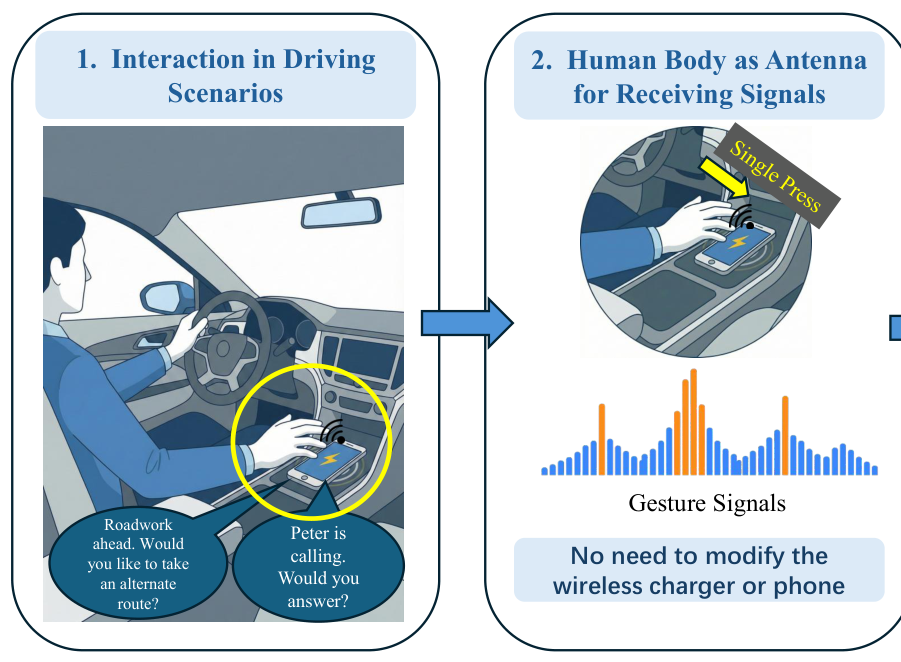
Turns the in-car wireless charger into a touch-free gesture sensor: seven mid-air gestures at 97.6% accuracy, with no changes to the charger or the phone.
Proceedings of the ACM on Interactive, Mobile, Wearable and Ubiquitous Technologies (UbiComp 2026) · September 2026
As vehicles evolve into digital living spaces, the demand for seamless human-vehicle interaction has surged. However, traditional interaction modalities impose critical safety and usability burdens. Touchscreens require visual attention (eyes-on), compromising driving safety, while voice assistants, although eyes-free, suffer from inherent latency, high cognitive load, and the intrusive disruption of cabin audio and social conversations. Mid-air gestures offer a promising shortcut for silent, immediate, and eyes-free control. Yet, enabling robust gesture sensing remains a challenge. Vision-based solutions can raise privacy and illumination concerns in some in-cabin deployments; millimeter-wave radar often increases hardware cost and integration complexity; and acoustic sensing can be affected by cabin noise and multipath interference in the in-cabin environment. To bridge this gap, we present MagHarp, a novel system that repurposes the ubiquitous in-car wireless charging pad for active gesture recognition. We observe that the human hand acts as a capacitive bridge within the near-field region, subtly modulating the charging signals. By treating the existing Wireless Power Transfer (WPT) hardware as a near-field electromagnetic sensor, we avoid modifying the charger or smartphone. MagHarp captures these minute impedance perturbations without modifying the transmitter. We design a robust pipeline featuring a lightweight CNN-BiLSTM network that helps distinguish driver gestures from vehicle-related disturbances and environmental interference. Extensive experiments across 5 chargers and 4 phones demonstrate that MagHarp achieves an average gesture recognition accuracy of 97.6% on a 3,500-sample dataset, effective up to 20 cm (recommended within 15 cm for robustness).
@article{wang2026magharp, title = {Eyes-Free, Touch-Free, and Worry-Free: Repurposing Wireless Chargers for Safer In-Car Gesture Interaction}, author = {Wang, Weiyi and Yang, Lanqing and Yu, Guo and Fan, Qinfei and Wu, Jeffery and Ge, Longyuan and Gan, Leo Linqian and Xue, Guangtao}, journal = {Proceedings of the ACM on Interactive, Mobile, Wearable and Ubiquitous Technologies}, volume = {10}, number = {3}, articleno = {164}, numpages = {34}, year = {2026}, month = sep, publisher = {Association for Computing Machinery}, address = {New York, NY, USA}, doi = {10.1145/3831984}, url = {https://doi.org/10.1145/3831984}, } -
- SenSys 2026
- CCF-B
- First student author
- Oral · SenSys 2026
SingSprite: Non-Tactile Appliance Interaction for the Blind through Power-Supply Acoustic Signatures
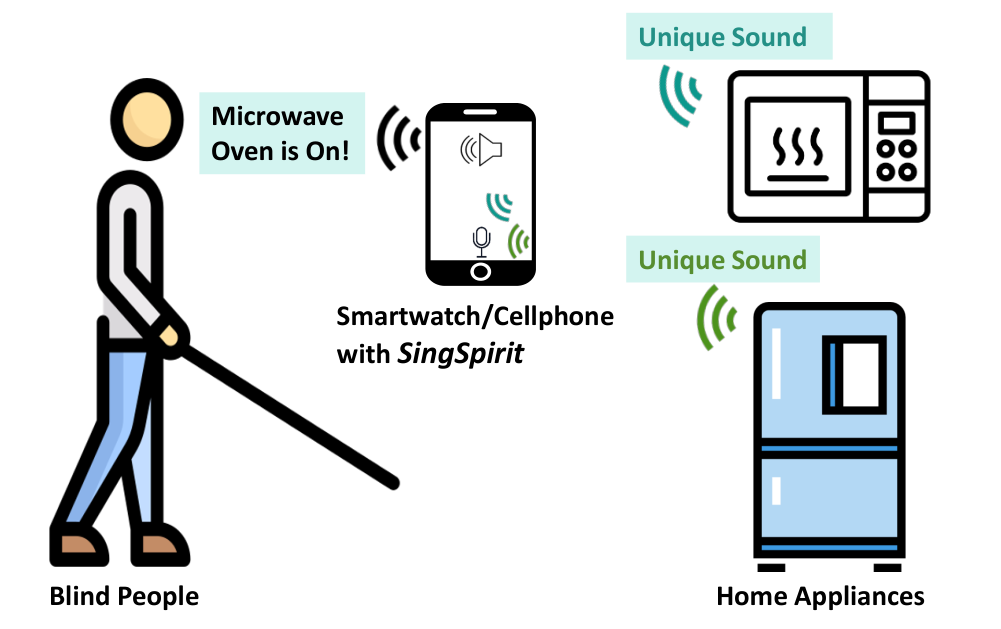
Recognizes home appliances and their working states from the hum of their power supplies, so blind users can operate them without touch: F1 of 0.95 across 100 appliances.
Proceedings of the ACM/IEEE International Conference on Embedded Artificial Intelligence and Sensing Systems (SenSys ’26), Saint Malo, France · May 2026
Touchscreen interfaces have become ubiquitous in modern household appliances, yet they remain largely inaccessible to the blind due to their lack of tactile feedback. Existing accessibility solutions, such as tactile overlays, remote control applications, and proximity-based interfaces, suffer from failing to capture real-time appliance states, limited generalizability, indirect interactions, or strong environmental dependencies. In this work, we introduce SingSprite, a novel appliance interaction system that allows blind users to seamlessly identify and control appliances by recognizing their unique acoustic signatures. The key insight is that many appliances emit distinct, device-specific humming sounds during operation, primarily generated by internal power supply components. SingSprite captures these acoustic fingerprints using commodity smartphone microphones, applying a tailored background noise cancellation scheme to enhance signal clarity. To address the issue of low mobile sampling rates, we integrate a Variational Mode Decomposition (VMD) approach with an autoencoder framework for effective feature extraction. The HumNet classifier, which concurrently classifies appliance types and operational states, demonstrates robust performance with an F1 score of 0.95 across a diverse set of 100 appliances. Additionally, user studies conducted with blind participants confirm the system’s usability and its practical effectiveness in real-world scenarios. SingSprite offers a hardware-free and scalable accessibility solution, providing proximity-aware interaction in smart homes without the need for additional infrastructure, paving the way for more inclusive and intuitive environments for blind users. Using natural device acoustics, SingSprite pioneers a universal, proximity-sensitive interaction paradigm that significantly advances accessibility in smart home environments, without requiring any modifications to existing infrastructure.
@inproceedings{yang2026singsprite,
  title = {SingSprite: Non-Tactile Appliance Interaction for the Blind through Power-Supply Acoustic Signatures},
  author = {Yang, Lanqing and Wang, Weiyi and Zhang, Yongzhao and Liu, Yixin and Chen, Yi-Chao and Xue, Guangtao and Ali, Ahmad},
  booktitle = {Proceedings of the ACM/IEEE International Conference on Embedded Artificial Intelligence and Sensing Systems (SenSys '26)},
  pages = {933--946},
  numpages = {14},
  year = {2026},
  month = may,
  location = {Saint Malo, France},
  publisher = {Association for Computing Machinery},
  address = {New York, NY, USA},
  isbn = {979-8-4007-2309-4},
  doi = {10.1145/3774906.3800505},
  url = {https://doi.org/10.1145/3774906.3800505},
}
Preprints
-
- arXiv 2026
- Co-author
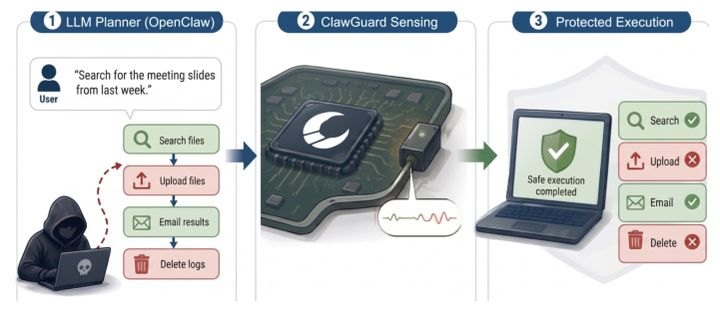
ClawGuard: Out-of-Band Detection of LLM Agent Workflow Hijacking via EM Side Channel
Audits LLM-agent workflows out of band from the electromagnetic emanations of the host, captured by external software-defined radios: AUC of 0.9945 on a 7.82 TB RF corpus.
arXiv preprint arXiv:2605.06205 · May 2026
Autonomous LLM agents face a critical security risk known as workflow hijacking, where attackers subtly alter tool and skill invocations. Existing defenses rely on host-internal telemetry (such as audit logs), which can be forged if the host OS is compromised. To solve this, we introduce ClawGuard, a passive, out-of-band monitor that audits LLM-agent workflows using electromagnetic (EM) emanations. Because distinct agent skills create unique hardware usage patterns (computation, DRAM, network blocking), they emit measurable, macroscopic EM envelopes. External software-defined radios (SDRs) capture these physical signals. Using a drift-aware pipeline with 320-dimensional features, ClawGuard converts RF streams into physical evidence. Evaluated on a 7.82TB RF corpus, ClawGuard achieved an AUC of 0.9945, detecting attacks with a 100% true-positive rate and a 1.16% false-positive rate. This proves passive EM sensing is a practical, forge-resistant physical check against compromised host software.
@article{gan2026clawguard, title = {ClawGuard: Out-of-Band Detection of LLM Agent Workflow Hijacking via EM Side Channel}, author = {Gan, Leo Linqian and Wu, Jeffery and Ge, Longyuan and Yang, Lanqing and Song, Yonghao and Zhang, Jingkai and Jin, Haojia and Wang, Weiyi and Xue, Guangtao}, journal = {arXiv preprint arXiv:2605.06205}, year = {2026}, month = may, } -
- arXiv 2025
- First author
The Wireless Charger as a Gesture Sensor: A Novel Approach to Ubiquitous Interaction
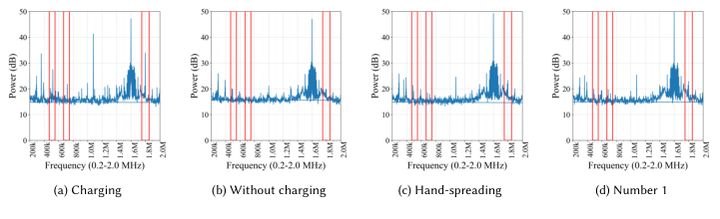
Recognizes contactless gestures from the electromagnetic signals of Qi wireless chargers: over 97% accuracy in experiments with 30 participants, 10 mobile devices and 5 chargers.
arXiv preprint arXiv:2511.16989 · November 2025
Advancements in information technology have increased demand for natural human-computer interaction in areas such as gaming, smart homes, and vehicles. However, conventional approaches like physical buttons or cameras are often limited by contact requirements, privacy concerns, and high costs. Motivated by the observation that these EM signals are not only strong and measurable but also rich in gesture-related information, we propose EMGesture, a novel contactless interaction technique that leverages the electromagnetic (EM) signals from Qi wireless chargers for gesture recognition. EMGesture analyzes the distinctive EM features and employs a robust classification model. The end-to-end framework enables it capable of accurately interpreting user intent. Experiments involving 30 participants, 10 mobile devices, and 5 chargers showed that EMGesture achieves over 97% recognition accuracy. Corresponding user studies also confirmed higher usability and convenience, which demonstrating that EMGesture is a practical, privacy-conscious, and cost-effective solution for pervasive interaction.
@article{wang2025wireless,
  title = {The Wireless Charger as a Gesture Sensor: A Novel Approach to Ubiquitous Interaction},
  author = {Wang, Weiyi and Yang, Lanqing and Gan, Linqian and Xue, Guangtao},
  journal = {arXiv preprint arXiv:2511.16989},
  year = {2025},
  month = nov,
}