~/projects/magharp
MagHarp
Turning the in-car wireless charger into a touch-free gesture sensor.
- IMWUT / UbiComp 2026
- CCF-A
- First author
- Oral · UbiComp/ISWC 2026
- accuracy, 7 gestures
- 97.6%
- gesture samples
- 3,500
- chargers × phones
- 5 × 4
- sensing range
- 20 cm
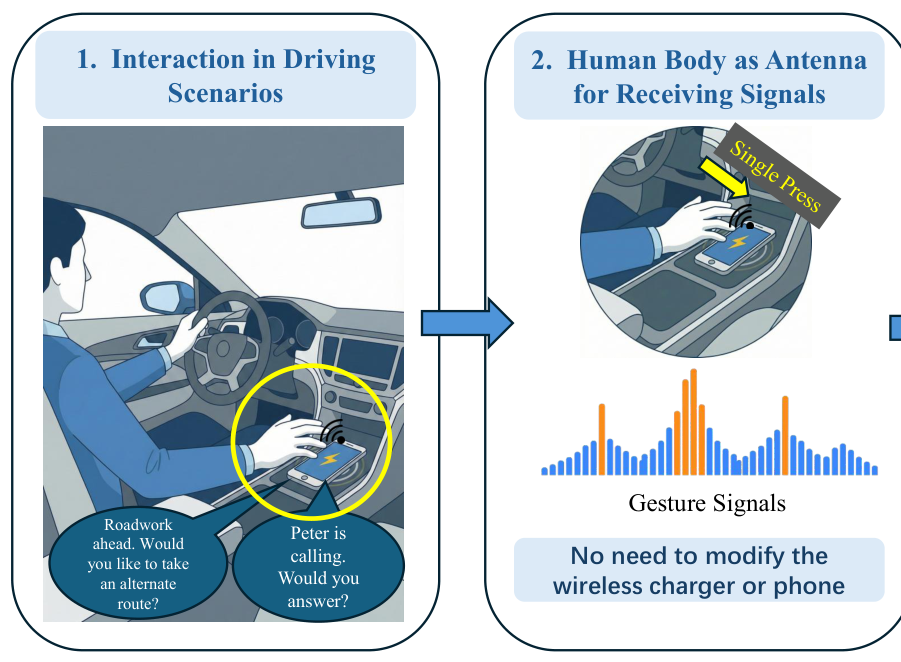
MagHarp repurposes the wireless charging pad that is already built into many cars as a near-field electromagnetic sensor, so that the driver can answer a call or change the route with a mid-air gesture: no touchscreen, no voice command, and no modification to the charger or the phone (Wang et al., 2026). Published in September 2026.

Demo
Why
Touchscreens take the driver’s eyes off the road. Voice assistants are slow, struggle with cabin noise and interrupt music and conversations. Mid-air gestures are silent and immediate, but cameras raise privacy and lighting concerns, millimeter-wave radar adds cost and integration effort, and acoustic sensing suffers from cabin noise and multipath.
Key idea
- During Qi wireless charging, the pad emits strong near-field signals. A hand moving above it acts as a capacitive bridge and subtly modulates these signals.
- A low-cost seat retrofit, a piece of conductive fabric on the seat surface, couples the driver’s body to the receiver, so the body works as an antenna and the perturbations can be picked up without touching the charger or the phone.
System


Results
- 97.6% average accuracy over 7 gestures on a 3,500-sample dataset.
- Generalizes across 5 wireless chargers and 4 smartphones, including on-road driving data.
- Works up to 20 cm above the pad (15 cm recommended for robustness).

My role
First author. I designed the conductive-fabric seat prototype, built the signal-processing and gesture-recognition pipeline, and carried out the experiments. I presented the paper in an oral session at UbiComp / ISWC 2026 in Shanghai.
Publication
-
- IMWUT 2026
- CCF-A
- First author
- Oral · UbiComp/ISWC 2026
Eyes-Free, Touch-Free, and Worry-Free: Repurposing Wireless Chargers for Safer In-Car Gesture Interaction
Turns the in-car wireless charger into a touch-free gesture sensor: seven mid-air gestures at 97.6% accuracy, with no changes to the charger or the phone.
Proceedings of the ACM on Interactive, Mobile, Wearable and Ubiquitous Technologies (UbiComp 2026) · September 2026
As vehicles evolve into digital living spaces, the demand for seamless human-vehicle interaction has surged. However, traditional interaction modalities impose critical safety and usability burdens. Touchscreens require visual attention (eyes-on), compromising driving safety, while voice assistants, although eyes-free, suffer from inherent latency, high cognitive load, and the intrusive disruption of cabin audio and social conversations. Mid-air gestures offer a promising shortcut for silent, immediate, and eyes-free control. Yet, enabling robust gesture sensing remains a challenge. Vision-based solutions can raise privacy and illumination concerns in some in-cabin deployments; millimeter-wave radar often increases hardware cost and integration complexity; and acoustic sensing can be affected by cabin noise and multipath interference in the in-cabin environment. To bridge this gap, we present MagHarp, a novel system that repurposes the ubiquitous in-car wireless charging pad for active gesture recognition. We observe that the human hand acts as a capacitive bridge within the near-field region, subtly modulating the charging signals. By treating the existing Wireless Power Transfer (WPT) hardware as a near-field electromagnetic sensor, we avoid modifying the charger or smartphone. MagHarp captures these minute impedance perturbations without modifying the transmitter. We design a robust pipeline featuring a lightweight CNN-BiLSTM network that helps distinguish driver gestures from vehicle-related disturbances and environmental interference. Extensive experiments across 5 chargers and 4 phones demonstrate that MagHarp achieves an average gesture recognition accuracy of 97.6% on a 3,500-sample dataset, effective up to 20 cm (recommended within 15 cm for robustness).
@article{wang2026magharp,
  title = {Eyes-Free, Touch-Free, and Worry-Free: Repurposing Wireless Chargers for Safer In-Car Gesture Interaction},
  author = {Wang, Weiyi and Yang, Lanqing and Yu, Guo and Fan, Qinfei and Wu, Jeffery and Ge, Longyuan and Gan, Leo Linqian and Xue, Guangtao},
  journal = {Proceedings of the ACM on Interactive, Mobile, Wearable and Ubiquitous Technologies},
  volume = {10},
  number = {3},
  articleno = {164},
  numpages = {34},
  year = {2026},
  month = sep,
  publisher = {Association for Computing Machinery},
  address = {New York, NY, USA},
  doi = {10.1145/3831984},
  url = {https://doi.org/10.1145/3831984},
}