~/projects/singsprite
SingSprite
Helping blind users interact with home appliances through the hum of their power supplies.
- SenSys 2026
- CCF-B
- First student author
- Oral · SenSys 2026
- F1, 100 appliances
- 0.95
- F1, 8 device types
- 0.92
- blind participants
- 16
- per interaction
- 1.5 s
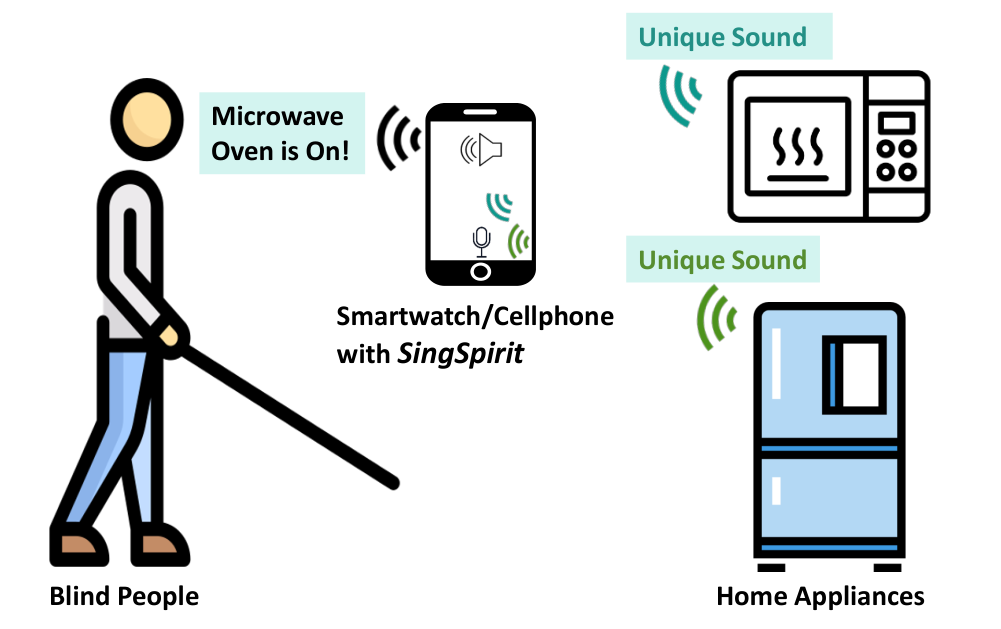
Touchscreen appliances give blind users no tactile feedback, and it is hard for them to tell whether a device is on or which program it is running. SingSprite lets a smartphone or smartwatch recognize nearby appliances and their working states from the high-frequency “humming” that their power-supply modules emit, and reports back through voice and vibration (Yang et al., 2026). Published in May 2026.

Demo
Why
Physical buttons can tell users where controls are by touch, but that feedback disappears on flat panels. A smart-home app also typically needs the appliance to be connected or configured in advance. SingSprite uses sounds that many existing appliances already emit so the same phone or watch can assist across different devices.
Key idea
A switched-mode power supply can emit faint high-frequency sound while operating. Changes in electrical load can shift its spectral pattern, so a short audio clip can carry cues about both the appliance and its current state. The spectrograms below compare the patterns of a lamp and projector across several settings.

System
- No tags, no retrofitting. Appliances are identified by the acoustic fingerprint of their switched-mode power supplies, captured with commodity microphones.
- Noise removal. Variational mode decomposition (VMD) suppresses speech, music and other background sounds.
- Low sampling rates. An FCN-BLSTM autoencoder recovers stable features from the low-sampling-rate microphones of phones and watches.
- Joint recognition. A multi-stage LSTM classifier, HumNet, recognizes the appliance type and its working state at the same time.

Evaluation
- Appliance and state recognition: end-to-end F1 of 0.95 across 100 appliances.
- Cross-device test: overall F1 of 0.92 when evaluated across eight different kinds of mobile devices. Microphone frequency response affected performance.
- User study: with 16 blind participants, SingSprite averaged 35 cm of working distance and 1.5 seconds per interaction in the study tasks. The comparison with RFID reported 5 cm and 2.5 seconds respectively.
The system depends on an appliance producing a usable acoustic signature. Recognition performance varies with microphone response, background noise and distance.

My role
I helped implement the system and contributed to experimental data collection and analysis. I am the first student author, and I gave the oral presentation at SenSys 2026 in Saint-Malo, France.
Publication
-
- SenSys 2026
- CCF-B
- First student author
- Oral · SenSys 2026
SingSprite: Non-Tactile Appliance Interaction for the Blind through Power-Supply Acoustic Signatures
Recognizes home appliances and their working states from the hum of their power supplies, so blind users can operate them without touch: F1 of 0.95 across 100 appliances.
Proceedings of the ACM/IEEE International Conference on Embedded Artificial Intelligence and Sensing Systems (SenSys ’26), Saint Malo, France · May 2026
Touchscreen interfaces have become ubiquitous in modern household appliances, yet they remain largely inaccessible to the blind due to their lack of tactile feedback. Existing accessibility solutions, such as tactile overlays, remote control applications, and proximity-based interfaces, suffer from failing to capture real-time appliance states, limited generalizability, indirect interactions, or strong environmental dependencies. In this work, we introduce SingSprite, a novel appliance interaction system that allows blind users to seamlessly identify and control appliances by recognizing their unique acoustic signatures. The key insight is that many appliances emit distinct, device-specific humming sounds during operation, primarily generated by internal power supply components. SingSprite captures these acoustic fingerprints using commodity smartphone microphones, applying a tailored background noise cancellation scheme to enhance signal clarity. To address the issue of low mobile sampling rates, we integrate a Variational Mode Decomposition (VMD) approach with an autoencoder framework for effective feature extraction. The HumNet classifier, which concurrently classifies appliance types and operational states, demonstrates robust performance with an F1 score of 0.95 across a diverse set of 100 appliances. Additionally, user studies conducted with blind participants confirm the system’s usability and its practical effectiveness in real-world scenarios. SingSprite offers a hardware-free and scalable accessibility solution, providing proximity-aware interaction in smart homes without the need for additional infrastructure, paving the way for more inclusive and intuitive environments for blind users. Using natural device acoustics, SingSprite pioneers a universal, proximity-sensitive interaction paradigm that significantly advances accessibility in smart home environments, without requiring any modifications to existing infrastructure.
@inproceedings{yang2026singsprite,
  title = {SingSprite: Non-Tactile Appliance Interaction for the Blind through Power-Supply Acoustic Signatures},
  author = {Yang, Lanqing and Wang, Weiyi and Zhang, Yongzhao and Liu, Yixin and Chen, Yi-Chao and Xue, Guangtao and Ali, Ahmad},
  booktitle = {Proceedings of the ACM/IEEE International Conference on Embedded Artificial Intelligence and Sensing Systems (SenSys '26)},
  pages = {933--946},
  numpages = {14},
  year = {2026},
  month = may,
  location = {Saint Malo, France},
  publisher = {Association for Computing Machinery},
  address = {New York, NY, USA},
  isbn = {979-8-4007-2309-4},
  doi = {10.1145/3774906.3800505},
  url = {https://doi.org/10.1145/3774906.3800505},
}