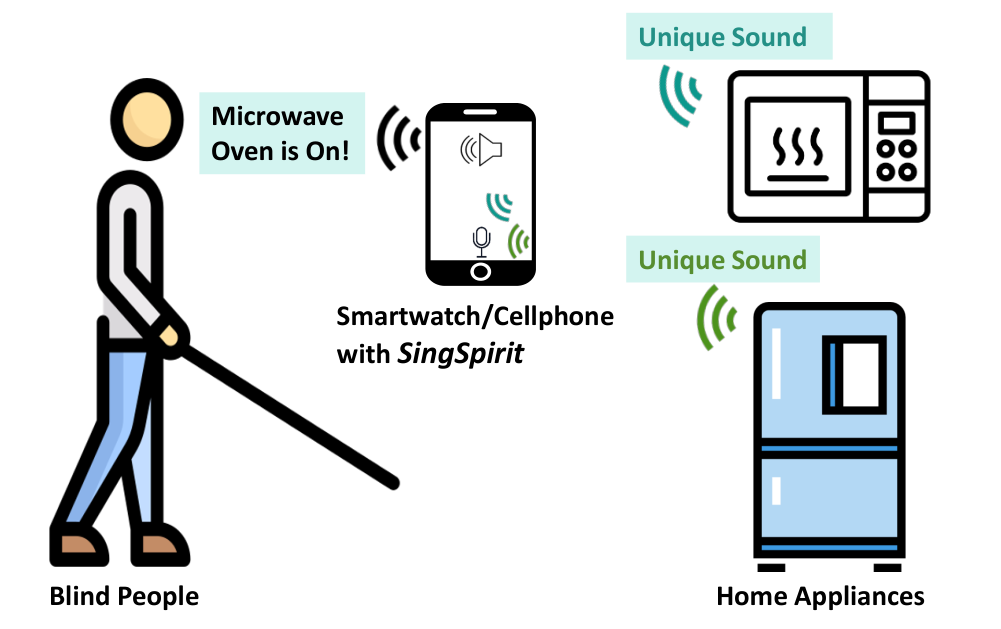
触屏家电缺少触觉反馈,盲人用户往往难以判断设备是否开启或正在执行哪个程序。SingSprite 让手机和智能手表从电源模块发出的高频声中识别附近家电及其状态,并通过语音和振动反馈。(Yang et al., 2026) 论文于 2026 年 5 月发表。

演示视频
为什么做
实体按键可以靠触摸定位,平整的触控面板却难以提供这类反馈。智能家居应用又通常要求家电预先联网或完成配对。SingSprite 利用许多现有设备本来就有的声音,让同一部手机或手表辅助识别不同的家电。
核心思路
开关电源工作时可发出微弱的高频声。用电负载随工作状态变化,声谱特征也可能随之改变,因此一段短录音能提供设备类型和运行状态两方面的信息。下图对比了灯具和投影仪在不同设置下的声谱。

系统流程
- 用普通麦克风采集开关电源的声学指纹,家电可直接使用,无需加装标签。
- 采用变分模态分解(VMD)抑制语音、音乐等背景噪声。
- 使用 FCN-BLSTM 自编码器从手机、手表的低采样率音频中提取稳定特征。
- 多阶段 LSTM 分类器 HumNet 联合识别家电类型和工作状态。

实验结果
- 联合识别:覆盖 100 台家电,端到端 F1 为 0.95。
- 跨设备测试:在 8 类移动设备上的总体 F1 为 0.92。麦克风的频率响应会影响识别表现。
- 用户实验:共有 16 名盲人参与者。在实验任务中,SingSprite 的平均交互距离为 35 厘米、平均用时为 1.5 秒;作为对照的 RFID 分别为 5 厘米和 2.5 秒。
系统依赖家电产生可检测的声学特征。麦克风响应、背景噪声和距离都会影响识别效果。

我的贡献
协助实现系统,并参与实验数据的采集与分析。论文署名为学生第一作者,并在法国圣马洛举行的 SenSys 2026 上作了口头报告。
相关论文
-
- SenSys 2026
- CCF-B
- 学生第一作者
- 口头报告 · SenSys 2026
SingSprite: Non-Tactile Appliance Interaction for the Blind through Power-Supply Acoustic Signatures
从开关电源的“嗡鸣”识别家电及其工作状态,帮助盲人免触控使用家电:在 100 台家电上 F1 达 0.95。
Proceedings of the ACM/IEEE International Conference on Embedded Artificial Intelligence and Sensing Systems (SenSys ’26), Saint Malo, France · 2026 年 5 月
Touchscreen interfaces have become ubiquitous in modern household appliances, yet they remain largely inaccessible to the blind due to their lack of tactile feedback. Existing accessibility solutions, such as tactile overlays, remote control applications, and proximity-based interfaces, suffer from failing to capture real-time appliance states, limited generalizability, indirect interactions, or strong environmental dependencies. In this work, we introduce SingSprite, a novel appliance interaction system that allows blind users to seamlessly identify and control appliances by recognizing their unique acoustic signatures. The key insight is that many appliances emit distinct, device-specific humming sounds during operation, primarily generated by internal power supply components. SingSprite captures these acoustic fingerprints using commodity smartphone microphones, applying a tailored background noise cancellation scheme to enhance signal clarity. To address the issue of low mobile sampling rates, we integrate a Variational Mode Decomposition (VMD) approach with an autoencoder framework for effective feature extraction. The HumNet classifier, which concurrently classifies appliance types and operational states, demonstrates robust performance with an F1 score of 0.95 across a diverse set of 100 appliances. Additionally, user studies conducted with blind participants confirm the system’s usability and its practical effectiveness in real-world scenarios. SingSprite offers a hardware-free and scalable accessibility solution, providing proximity-aware interaction in smart homes without the need for additional infrastructure, paving the way for more inclusive and intuitive environments for blind users. Using natural device acoustics, SingSprite pioneers a universal, proximity-sensitive interaction paradigm that significantly advances accessibility in smart home environments, without requiring any modifications to existing infrastructure.
@inproceedings{yang2026singsprite,
  title = {SingSprite: Non-Tactile Appliance Interaction for the Blind through Power-Supply Acoustic Signatures},
  author = {Yang, Lanqing and Wang, Weiyi and Zhang, Yongzhao and Liu, Yixin and Chen, Yi-Chao and Xue, Guangtao and Ali, Ahmad},
  booktitle = {Proceedings of the ACM/IEEE International Conference on Embedded Artificial Intelligence and Sensing Systems (SenSys '26)},
  pages = {933--946},
  numpages = {14},
  year = {2026},
  month = may,
  location = {Saint Malo, France},
  publisher = {Association for Computing Machinery},
  address = {New York, NY, USA},
  isbn = {979-8-4007-2309-4},
  doi = {10.1145/3774906.3800505},
  url = {https://doi.org/10.1145/3774906.3800505},
}