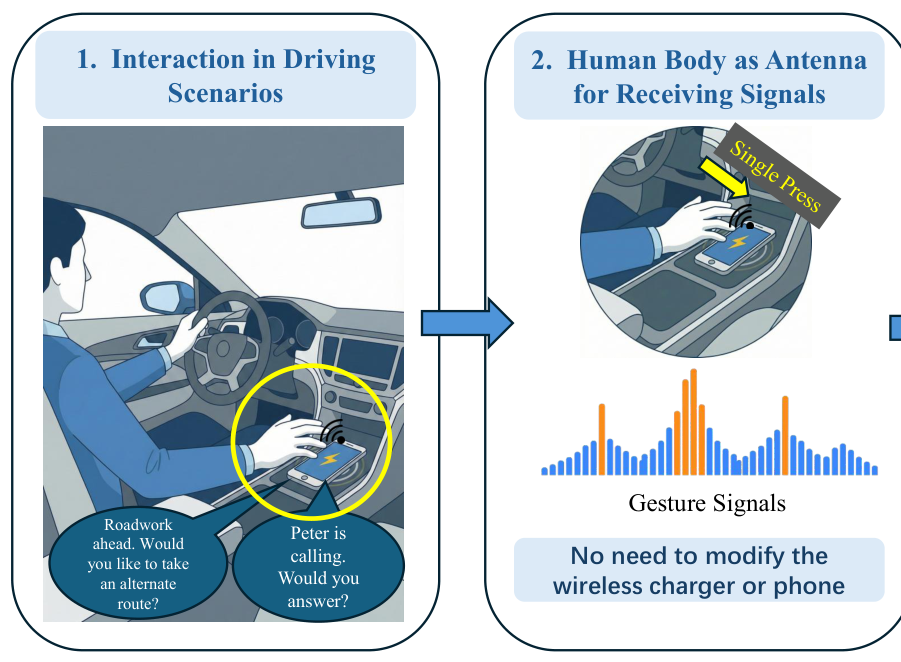
MagHarp 将车内已有的无线充电板用作近场电磁传感器。驾驶员可以在充电板上方做手势,接听电话或处理导航提示,无需操作触屏,也无需改装充电器或手机。(Wang et al., 2026) 论文于 2026 年 9 月发表。

演示视频
工作原理
Qi 无线充电产生的近场信号会被上方移动的手扰动。在座椅表面加装低成本导电布后,驾驶员身体可耦合至接收端,充当近场天线。系统采集信号,经短时傅里叶变换、背景扣除、谐波频带筛选与拼接、归一化后,用轻量 CNN-BiLSTM 识别手势。


实验结果
- 在 3,500 个样本上识别 7 种手势,平均准确率为 97.6%。
- 验证覆盖 5 款无线充电器和 4 款手机,包含实际道路行驶数据。
- 感知范围可达充电板上方 20 厘米,建议在 15 厘米内使用以获得更稳定的结果。

我的贡献
第一作者。设计导电布座椅原型,搭建信号处理和手势识别流程,并完成实验。在上海举行的 UbiComp / ISWC 2026 上作了该论文的口头报告。
相关论文
-
- IMWUT 2026
- CCF-A
- 第一作者
- 口头报告 · UbiComp/ISWC 2026
Eyes-Free, Touch-Free, and Worry-Free: Repurposing Wireless Chargers for Safer In-Car Gesture Interaction
把车载无线充电器变成隔空手势传感器:识别 7 种手势,平均准确率 97.6%,无需改装充电器或手机。
Proceedings of the ACM on Interactive, Mobile, Wearable and Ubiquitous Technologies (UbiComp 2026) · 2026 年 9 月
As vehicles evolve into digital living spaces, the demand for seamless human-vehicle interaction has surged. However, traditional interaction modalities impose critical safety and usability burdens. Touchscreens require visual attention (eyes-on), compromising driving safety, while voice assistants, although eyes-free, suffer from inherent latency, high cognitive load, and the intrusive disruption of cabin audio and social conversations. Mid-air gestures offer a promising shortcut for silent, immediate, and eyes-free control. Yet, enabling robust gesture sensing remains a challenge. Vision-based solutions can raise privacy and illumination concerns in some in-cabin deployments; millimeter-wave radar often increases hardware cost and integration complexity; and acoustic sensing can be affected by cabin noise and multipath interference in the in-cabin environment. To bridge this gap, we present MagHarp, a novel system that repurposes the ubiquitous in-car wireless charging pad for active gesture recognition. We observe that the human hand acts as a capacitive bridge within the near-field region, subtly modulating the charging signals. By treating the existing Wireless Power Transfer (WPT) hardware as a near-field electromagnetic sensor, we avoid modifying the charger or smartphone. MagHarp captures these minute impedance perturbations without modifying the transmitter. We design a robust pipeline featuring a lightweight CNN-BiLSTM network that helps distinguish driver gestures from vehicle-related disturbances and environmental interference. Extensive experiments across 5 chargers and 4 phones demonstrate that MagHarp achieves an average gesture recognition accuracy of 97.6% on a 3,500-sample dataset, effective up to 20 cm (recommended within 15 cm for robustness).
@article{wang2026magharp,
  title = {Eyes-Free, Touch-Free, and Worry-Free: Repurposing Wireless Chargers for Safer In-Car Gesture Interaction},
  author = {Wang, Weiyi and Yang, Lanqing and Yu, Guo and Fan, Qinfei and Wu, Jeffery and Ge, Longyuan and Gan, Leo Linqian and Xue, Guangtao},
  journal = {Proceedings of the ACM on Interactive, Mobile, Wearable and Ubiquitous Technologies},
  volume = {10},
  number = {3},
  articleno = {164},
  numpages = {34},
  year = {2026},
  month = sep,
  publisher = {Association for Computing Machinery},
  address = {New York, NY, USA},
  doi = {10.1145/3831984},
  url = {https://doi.org/10.1145/3831984},
}